The Polycentric Workforce: Redefining HQ vs. Regional Dynamics
Welcome back to our blog series where we demystify the work we do at noodle, a qualitative research and strategy agency committed to driving user-centered impact and innovation.
When an enterprise expands globally, its leadership typically focuses on scaling its operational infrastructure: setting up international legal entities, unifying global payroll, and standardizing product localized code. But as the organization grows, a silent and incredibly destructive friction often begins to spark between the primary headquarters (HQ) and its international satellite offices.
From an anthropological view, this friction is a textbook case of corporate ethnocentrism. A dominant, centralized headquarters routinely mistakes its localized cultural values (whether that is a Silicon Valley style of blunt transparency, an East Coast drive for individualistic competition, or a Northern European fixation on rigid timelines) for universal business truths. When HQ blindly forces these domestic norms onto regional offices in Tokyo, São Paulo, or Nairobi, the result is widespread regional alienation, plummeting talent retention, and broken go-to-market strategies.
At noodle, we help global enterprises move past this top-down model. Through our specialized capability in decentralized organizational alignment, we help companies transition into a polycentric workforce architecture, an approach that dismantles HQ cultural bias and unlocks the true operational agility of your global teams.
The Traps of Ethnocentric Leadership
In cross-cultural management theory, organizations expanding internationally typically evolve through three cultural stages: Ethnocentric (HQ knows best), Polycentric (Host countries know best), and Geocentric (A integrated global mindset).
Many scaling companies get stuck in the ethnocentric trap, resulting in three distinct operational failures:
1. The Imperial Mandate (Linguistic Bias)
HQ routinely dominates global communications, setting all hands at times that require international teams to log on at midnight, using highly localized slang, or relying on domestic sports metaphors ("touching base," "homerun") that alienate regional staff. This subtle exclusion sends a clear signal: The satellite offices are secondary citizens.
2. The Performance Metric Mismatch
When a centralized HR team designs a global performance review process based on domestic cultural ideals, it penalizes regional top-performers. For example, forcing a self-promotional, individualistic evaluation rubric onto a collectivistic culture like Japan or South Korea will cause employees to downplay their achievements out of modesty, leading HQ to mistakenly conclude that the regional office lacks ambitious talent.
3. Strategic Blindness through Corporate "Gaze"
When local managers try to warn HQ that a global product line or marketing campaign will fail locally due to cultural nuances, their feedback is frequently dismissed by central executives as "regional resistance." This corporate blindness destroys local employee morale and costs millions in failed international product launches.
Shift the Paradigm: The Polycentric Matrix
A polycentric workforce architecture recognizes that there are multiple centers of cultural gravity within a global enterprise. noodle research + strategy looks at your global footprint as a network of distinct cultural nodes that must be harmonized, not homogenized.
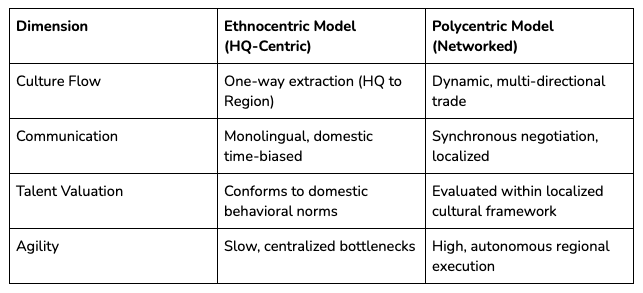
The Goal of Decentralized Alignment: True polycentrism does not mean creating isolated, chaotic silos. It means defining a small set of universal core values (the "corporate DNA") while allowing the behavioral expression of those values to be highly localized by regional teams.
How noodle Builds Decentralized Alignment
We map the hidden cultural distances between your regional nodes to turn cross-border friction into an unfair operational advantage:
Global Interaction Mapping: We track the digital workflows, communication tools, and meeting schedules between your primary headquarters and satellite locations. We expose the hidden imbalances (such as who is always compromising their sleep or working hours) to build a more sustainable, equitable operational rhythm.
Metric De-Biasing: We audit your global HR practices, recruitment pipelines, and performance scorecards to eliminate localized cultural biases, ensuring you accurately spot, reward, and retain brilliant international leaders.
Cultural Intelligence (CQ) Infrastructure: We don't deliver boring, generic cultural sensitivity training. We help you build a concrete internal framework (including rotational assignment programs, cross-border shadow networks, and specialized translation protocols) to weave international perspectives directly into your core product development lifecycle.
noodle's Capability: Decentralized Organizational Alignment
Your international offices shouldn't just be low-cost execution centers; they are your most vital source of diverse innovation and local market wisdom. At noodle research + strategy, we help you bridge the geographic chasm to align your global workforce seamlessly.
We help you:
Audit HQ Ethnocentrism: Pinpointing the communication, policy, and metric blind spots that are driving costly turnover in your international hubs.
Design Polycentric Governance Models: Structuring decentralized decision-making loops that balance corporate consistency with local speed.
Align Cross-Border Teams for Innovation: Translating complex cultural differences into collaborative strengths to accelerate international market penetration.
Stop managing a global footprint with a domestic mindset. Let noodle research + strategy help you unify your distributed workforce into a highly agile, culturally fluent global ecosystem.
Stay tuned to learn more about how we translate insights into actionable strategies!
Please note that content for this article was developed with the support of artificial intelligence. As a small research consultancy with limited human resources we utilize emerging technologies in select instances to help us achieve organizational objectives and increase bandwidth to focus on client-facing projects and deliverables. We also appreciate the potential that AI-supported tools have in facilitating a more holistic representation of perspectives and capitalize on these resources to present inclusive information that the design research community values.