The Bureaucracy Hack: Mapping Everyday Resistance in Corporate Life
Welcome back to our blog series where we demystify the work we do at noodle, a qualitative research and strategy agency committed to driving user-centered impact and innovation.
When enterprise operations slow to a crawl, leadership teams typically audit their software, add project managers, or introduce new performance frameworks. They view efficiency as a purely technical problem. But when you look beneath the surface of daily corporate life, you find that the real obstacle isn't the software or the layout, it is a quiet, continuous civil war.
Employees rarely mount public rebellions against over-bureaucratic processes. Instead, they engage in what anthropologists call everyday resistance. They subtly stall, bypass, or invent clever workarounds to rewrite rigid corporate structures, all in an effort to retain personal autonomy and actually get their jobs done.
At noodle, we treat these internal "hacks" not as disciplinary issues, but as valuable diagnostic data. Through our specialized internal process friction analysis, we help leaders map these micro-rebellions to identify exactly where corporate systems are fundamentally broken.
The Anthropology of Everyday Resistance
In his seminal anthropological work, Weapons of the Weak, political scientist James C. Scott explored how individuals resist oppressive or inefficient hierarchies when they lack the power to change them openly. Instead of open rioting, they use quiet tactics: foot-dragging, feigned ignorance, false compliance, and unauthorized workarounds.
The modern corporate office operates on the exact same human playbook. When an enterprise introduces an over-engineered administrative process (such as requiring five layers of sign-off for a simple $50 software purchase) the employee base will not openly protest. Instead, they weaponize corporate bureaucracy against itself.
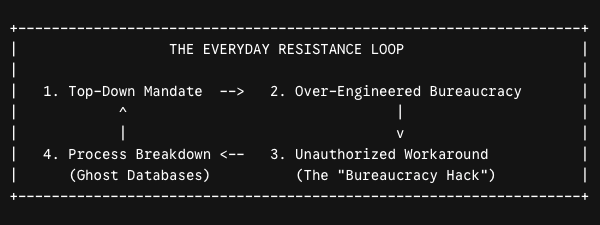
These quiet hacks manifest across three common operational patterns:
1. Strategic Foot-Dragging (The Low-Priority Stall)
When forced to use a new, painfully slow reporting tool, teams will universally agree to deprioritize it. They will complete it late, fill it out with the bare minimum information, or claim "system glitches." This isn't laziness; it is a collective, unspoken pact to protect their limited time from administrative bloat.
2. False Compliance (The Surface Performance)
Employees become masters of checking boxes without engaging in the spirit of the rule. They will click through mandatory training modules on double-speed while doing actual work on another monitor, or copy-paste identical text into weekly status reports just to satisfy an algorithmic tracking tool.
3. Ghost Databases (The Parallel Architecture)
When enterprise resource planning (ERP) systems become too rigid, teams quietly construct their own parallel architecture. They build massive, unauthorized "shadow" spreadsheets in Google Sheets or private Airtable databases to run the business, manually transferring data back to the official corporate system only when absolutely necessary.
Why Silencing the "Hackers" Backfires
The default executive response to discovering these workarounds is to crack down—locking down software permissions, auditing access, and mandating strict compliance. This is a critical strategic mistake.
Everyday resistance is a vital pressure valve. The employees inventing these workarounds are often your most resourceful, high-performing talent. They are hacking the system because they care more about delivering results for clients than preserving administrative purity. If you cut off their workarounds without fixing the root cause of the friction, you don't achieve compliance, you achieve operational paralysis, followed quickly by talent burnout and turnover.
How noodle Conducts a Process Friction Analysis
We don't rely on standard internal surveys, because employees will never openly admit to bypassing company policy on a digital form. noodle research + strategy embeds in your daily workflows to uncover the authentic operational landscape:
Digital Shadowing: We shadow your frontline teams as they navigate their actual daily tasks, watching for the exact moments they pivot away from official enterprise software to use a "homegrown" spreadsheet, private message channel, or personal device.
Friction Logging: We map the exact cognitive and temporal cost of your compliance requirements. We identify the "choke points" where administrative processes actively force employees to choose between systemic compliance and execution speed.
Workaround Reverse-Engineering: We treat every unauthorized employee hack as a working prototype. If an engineering team has built a messy, automated Slack bot to bypass an official ticketing queue, that bot contains the exact functional blueprint for how your next enterprise workflow should be designed.
noodle's Capability: Internal Process Friction Analysis
True operational agility cannot be mandated from the top down; it must be designed from the ground up based on real human behavior. At noodle research + strategy, we help you transform internal frustration into elegant, high-velocity operational design.
We help you:
Expose Shadow IT Safely: Identifying the parallel software tools and workflows your teams have built, without creating an environment of blame or surveillance.
Streamline Enterprise Workflows: Eliminating low-value administrative friction points that stall product development, sales cycles, and internal collaboration.
Design Human-Centric Compliance: Building internal safety, data, and financial controls that align naturally with the intuitive working habits of your employees.
Stop fighting your team's resourcefulness. Let noodle research + strategy help you decode your company's micro-rebellions and build processes that actually empower your people to execute.
Stay tuned to learn more about how we translate insights into actionable strategies!
Please note that content for this article was developed with the support of artificial intelligence. As a small research consultancy with limited human resources we utilize emerging technologies in select instances to help us achieve organizational objectives and increase bandwidth to focus on client-facing projects and deliverables. We also appreciate the potential that AI-supported tools have in facilitating a more holistic representation of perspectives and capitalize on these resources to present inclusive information that the design research community values.